
PHOTO
74038.0
An aromatic, subterranean, fruit of a fungi growing on the roots of specific host trees once the domain of European old-world forests has taken off in pockets of the Ovens and Murray region.
Perigold black truffles suited to the cool winters, reliable frosts, and well drained granitic soils are on the rise in North East Victoria well-renowned for its cool climate wines.
Local truffle grower Jill Croome from Baarmutha Truffles said Australia is now the fourth largest grower of black truffles in the world with farms in all states and territories except the Northern Territory.
“Truffles from the North East may have a competitive advantage as frost has a reputation in intensifying the aroma and flavour,” she said.
“The black truffle has a complex aroma of up to 100 volatile organic compounds, and is one of the most chemically complex natural foods ever studied.”
With most truffles exported overseas, Ms Croome said many truffle growers in Australia are trying to increase awareness of the exquisite ingredient and grow local markets.
“Most truffle farms in our region are smaller in scale, covering up to a couple of hectares of land,” she said.
A long-term commitment with particular species of host trees inoculated with truffle spores in their roots, spores need to be ordered, sometimes with long wait times.
Truffle fungi create a relationship with a host tree, usually oak or hazelnut, with both the tree and the truffle known as an ectomycorrhizal symbiosis.
Ms Croome said soil preparation to grow truffles in the North East required a particular pH (measure of the acid/alkalinity of the soil) much higher compared to other soils in the area.
“This means working in large amounts of soil amendments such as lime and the soil must also be free draining, and free of other fungal species that may compete with truffles,” she said.
“Growers have a long wait following preparation that can be anywhere from four years to never.
“We were thrilled to discover truffles growing in our orchard six years after planting.”
Maintaining production includes a cycle of pruning, irrigating, fertigating, re-inoculating, mowing and weeding.
Soil monitoring takes place for optimal truffle production, and to control pest species including rabbits, cockatoos and bugs.
“Although a fungus, truffles have a different life cycle to mushrooms with their fruiting body underground and invisible until harvested,” Ms Croome said.
“They start growing in late spring and ripen in winter with harvest from late June to early August.”
Highly trained dogs are used to accurately detect the aroma of ripe truffles growing underground.
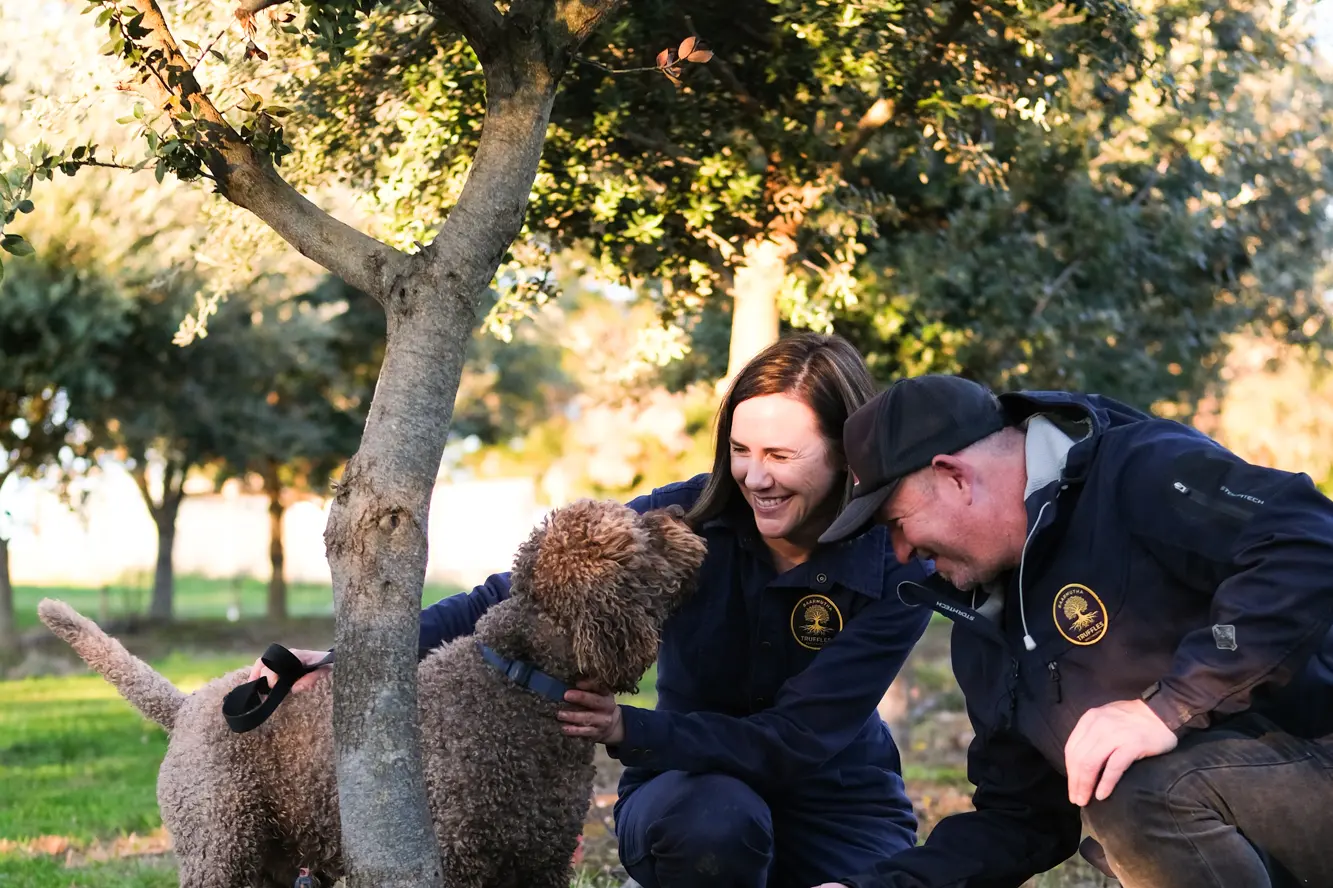
The Baarmutha Truffle grower has a Ligotti Romagnolo as the truffle dog (regarded as a partner) - a working breed traditionally used to hunt wild truffles in Europe.
Any type of dog can be a truffle dog with temperament and training key factors.
Truffles can be used in everyday cooking in simple dishes such as pasta, egg, risotto and potato where just a few shavings can transform a dish.
“The Blanchett white truffle is also being grown in the region, adding further diversity to the culinary offerings,” Ms Croome said.
“Truffles native to Australia aren’t edible or not very palatable, whereas the black and white truffles of Europe now being farmed in our region have been considered delicacies for thousands of years.
“They remain among the world’s most prized and valuable foods with perfect truffle specimens selling up to $3000/kilogram.
“Most growers sell directly to local restaurants, home cooks, and regional food events.
“Truffles have a short shelf life and are best consumed fresh.”