PHOTO
54257.0
Many of our Australian birds have weird and whacky names and one may well ponder over their origins.
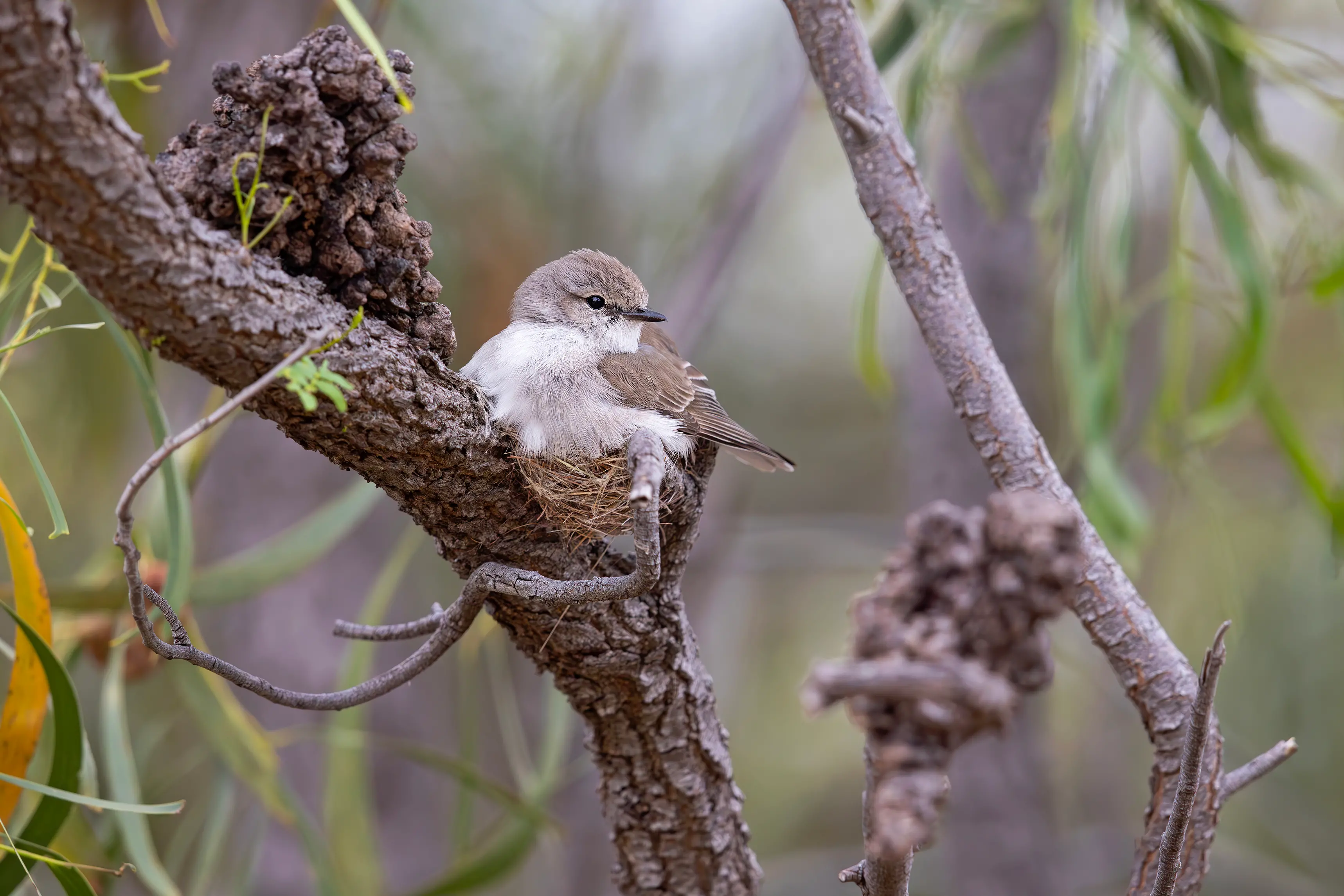
An example of this is the Jacky Winter – a small insect-eating bird that belongs to the family of Australian robins.
Despite looking and behaving like a robin, some ornithologists have previously treated this species as a flycatcher, even naming it the Brown Flycatcher for a time, although it isn’t really brown (it is more grey) and it’s not really a flycatcher! Confused? So are we…
So, how did the Jacky Winter get its name?
It all comes down to its distinctive call which, with a bit of imagination, sounds like ‘Jacky, Jacky, Jacky – Winter, Winter, Winter’.
Along with most other small songbirds, Jacky Winters are most vocal during spring, singing to establish a breeding territory early in the season, then continuing to sing right throughout the remainder of their breeding period.
They often call from the tops of dead trees and other exposed perches such as fence posts and fallen branches, especially at dawn but also regularly throughout the day.
Occupying areas of lightly timbered open woodland, locally Jacky Winters are found in areas fringing the Warby Range, the Barambogie Ranges and the Chiltern forests, however they also inhabit some areas of well-treed farmland, usually bordering roads or creeklines.
They prefer habitats with an open shrub layer with areas of bare ground and patches of leaf-litter and debris.
Jacky Winters take prey such as flies, moths, butterflies, beetles, termites and crickets.
They typically forage by sallying out from low perches such as a fallen branch, stump, post or wire, chasing insects on fluttering low flights and picking insects out of the air, from foliage, or from the ground, always returning to another perch to repeat the procedure.
At times, they may appear nervous as they restlessly swing their tail from side to side, but when perched they are actually rather confiding and can often be approached quite closely.
Jacky Winters are known to construct unusually tiny nests – among the smallest in proportion to their body size of any Australian bird.
From July to September, both sexes contribute to building a frail saucer of fine grasses, rootlets and sometimes hair, bound together with cobweb and decorated with lichen or bark, and lined with finer fibres and feathers.
They build their nests high on a large bare branch or horizontal fork.
Once the female has laid her two to three eggs, both her and her mate incubate the eggs for around 18 days until hatching.
Again, both parents share the task of raising the young until they fledge, which is around another 18 days.